
Shipbuilding is in the middle of a historic order boom, and laser cutting is moving from a niche tool to a standard part of shipyard production. This guide looks at the 2026 market picture, where laser cutting genuinely earns its place in a shipyard (and where it does not yet), and how to choose the right tube and plate laser machines for ship-related work.
The 2026 shipbuilding boom, in numbers
Global newbuilding activity is at record levels. Chinese yards took about 72% of worldwide newbuilding orders in the first half of 2026, with South Korea at 19% (iMarineNews, Jul 2026). Chinese shipbuilders’ orders by tonnage in H1 2026 surged 173% year on year, eclipsing the previous full-year record (Seatrade Maritime, Jul 2026). Clarksons reports 839 ships of 26.1 million CGT ordered in the first four months of 2026 alone, and delivery slots at leading yards now extend into 2029–2030.
For equipment suppliers, the consequence is simple: yards and their subcontractors are investing heavily in capacity and modernization, and cutting equipment is at the top of the shopping list.
Where laser cutting earns its place in a shipyard
It helps to be precise about thickness. High-power fiber lasers in the 8–30 kW range handle ship steel efficiently up to roughly 30–40 mm, with 20–30 mm being the sweet spot widely compared against plasma and flame cutting (Glory Laser, Apr 2026). Beyond that, very thick hull plate and heavy bevels still belong to plasma and oxy-fuel. In practice, that leaves lasers with a large and growing share of shipyard work:
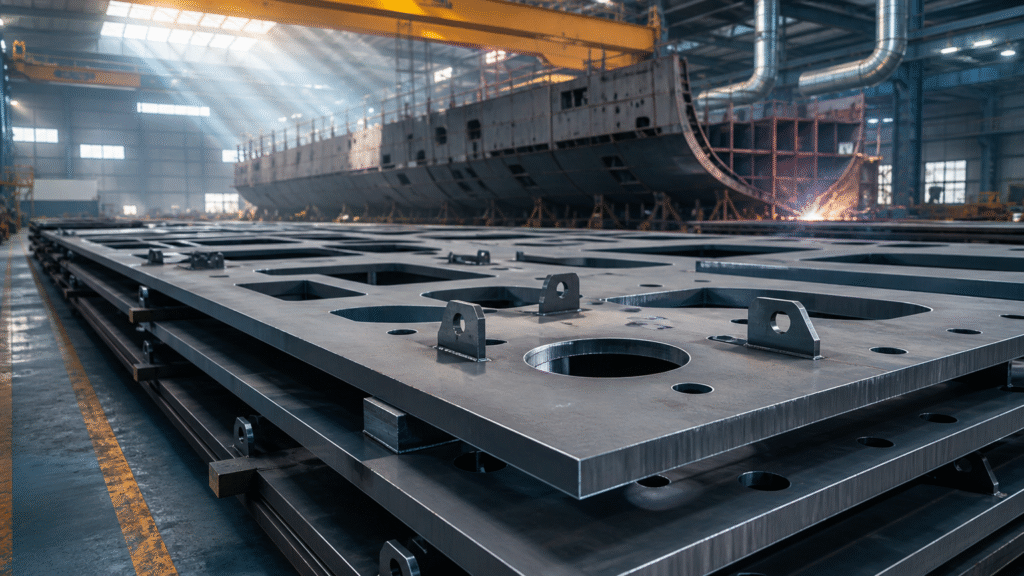
- Hull and deck panels, 3–25 mm — brackets, floors, stiffener webs, manhole and access openings cut with ±0.1 mm accuracy and minimal thermal distortion.
- Profiles and stiffeners — angle bars, flat bars and bulb flats cut to length with bevel options, ready for welding.
- Pipework — marine pipes and pipe spools (round, square, and rectangular tubes) with precise flange holes and openings; laser cutting prevents heat-affected-zone corrosion in stainless steel piping.
- Interior and outfitting parts — custom panels, railings, brackets and equipment supports cut in small batches without tooling changes.
This is why shipbuilding demand splits into two machine families: tube lasers for pipes, profiles and stiffeners, and plate lasers for panels and brackets.
Why yards and subcontractors are switching from plasma and flame
- Edge quality and distortion. Plasma cutting of thick plate typically leaves 2–3 mm thermal deformation; laser keeps it within about 0.5 mm, and edges need little or no grinding before welding.
- Weld rework savings. A 12 kW fiber laser installation at Hyundai Heavy Industries reduced hull plate assembly errors to under 1 mm and cut welding rework by roughly 90% — a widely cited early adopter case.
- Material utilization. Nesting software typically improves plate utilization by 15–20%, which on 10,000-ton steel projects translates into large annual material savings.
- Gas economics at high power. At 20–30 kW, air-assisted cutting of carbon steel reduces nitrogen consumption on many jobs, lowering per-part gas cost.
- Cleaner workshops. Laser produces far less fume than plasma, which helps yards meet stricter environmental and worker-safety requirements.
- Automation fit. Fiber lasers integrate naturally with robotic cells, automatic loading and nesting software — the backbone of modern “digital shipyard” initiatives.
Choosing machines for ship-related work
| What you cut | Recommended machine | Typical configuration |
|---|---|---|
| Marine pipes & pipe spools | Tube laser (i-series) | Ø20–160 mm (i6) to Ø50–500 mm (i20), 3D cutting head, bevel, CyberFab nesting & production software |
| Profiles, stiffeners, bulb flats | Tube laser (i-series) | Up to 12 m tube length, angle/channel/H-beam processing, weld-ready bevels |
| Panels, brackets, floors (3–25 mm) | Plate laser (8–20 kW) | 6–12 m beds, dual-pallet exchange platforms for continuous cutting |
| Heavy hull plate (>40 mm) and heavy bevels | Plasma / oxy-fuel (or large gantry laser where justified) | — |
For a shipyard subcontractor, the typical first purchase is a tube laser: pipes and profiles are the highest-volume laser-cut work, and machines like the JQ i-series (Ø20–160 mm on the i6, up to Ø500 mm on the i20) process them with 0-tail-residue chucking, 3D bevel cutting and MicroStep CyberFab Industry 4.0 software. Plate machines then cover panels and brackets as volume grows. See the i-series buying guide for full specifications.
2026–2030 outlook: what to expect
- Power keeps rising. 30 kW is now mainstream for plate work, 60 kW systems are commercial, and air cutting at high power keeps eroding nitrogen costs.
- Order-boom capacity investment. With delivery slots sold into 2029–2030, yards will keep buying automation-friendly cutting equipment rather than labor-intensive plasma tables.
- Digital shipyard. Nesting, production monitoring and machine-data integration (the Industry 4.0 stack) become purchase requirements, not options.
- Broader laser adoption. Laser welding and laser cleaning are following cutting into shipyards; combined cutting-welding workstations are emerging.
- New ship types. LNG carriers, methanol and ammonia-ready vessels and specialized tonnage keep the material mix diverse — good news for flexible, multi-material laser cells.
Quick checklist before you buy for ship work
- List the parts you actually cut: pipes, profiles, panels — then size the machine family.
- Choose tube capacity by your largest pipe or profile section and length (i6: Ø20–160 mm; i20: up to Ø500 mm).
- Match plate laser power to your typical panel thickness (8–12 kW covers most work up to 25 mm).
- Verify bed length against your longest plate or tube to avoid re-cutting and seams.
- Confirm 3D bevel capability if you supply weld-ready stiffeners and profiles.
- Check the software stack: nesting, CAM and production monitoring should be demonstrated, not promised.
- Ask for sample cutting on your real pipe and plate parts before ordering.
- Clarify installation, training and spare parts response in your region (JQ: 24h service hotline).
- Budget consumables (nozzles, lenses, protective windows) for at least two years.
- Request a reference list from suppliers with shipbuilding customers, and verify service reputation.
FAQ
Can a fiber laser replace plasma for hull plate cutting?
For plate up to roughly 30–40 mm, high-power fiber lasers (20–30 kW) match or beat plasma on edge quality, distortion and running cost, and are increasingly used for panels and structural parts. For very thick hull plate and heavy bevels, plasma and oxy-fuel remain standard; many yards run both technologies side by side.
Which laser cutting machine is used most in shipbuilding?
Two families dominate: tube/profile lasers for pipes, stiffeners and sections, and plate lasers for panels and brackets. For subcontractors, the tube laser is usually the first and most profitable purchase because pipe and profile work is high-volume and well suited to laser processing.
Can laser cutting handle shipbuilding steel like AH36?
Yes. High-strength shipbuilding steels such as AH36/DH36 are routinely laser cut; cutting parameters are tuned per grade, and laser edges are generally weld-ready with little or no grinding.
Does laser cutting save material in shipyards?
Yes. Nesting software typically improves plate utilization by 15–20%, which is one of the largest measurable savings on steel-intensive projects.
How fast is the shipbuilding market growing?
Chinese yards alone took about 72% of global newbuilding orders in H1 2026, with H1 order tonnage up 173% year on year and orderbooks booked into 2029–2030 (iMarineNews, Seatrade Maritime, 2026).
Do I need a plate laser or a tube laser first?
Start with the parts you sell. If you supply pipe spools and stiffeners, a tube laser (i-series) pays back fastest. If you cut panels and brackets, a plate machine is the right first step. Many suppliers add the second machine within 12–24 months.
