
Choosing a plate laser cutting machine starts with a practical question: will the proposed working area accommodate the sheets and parts you actually process?
A model name helps identify a machine, but it is not a substitute for confirmed working dimensions. Review sheet width and length, part layouts, positioning requirements and material handling before selecting a configuration.
This guide explains what to check, using a U.S. customer installation as an example.
1. Start with the Sheets You Buy
List the actual dimensions of your regular sheet stock, together with material and thickness. Separate the sizes used for most orders from larger sheets required only occasionally.
Use the units familiar to your workshop. If you purchase material in feet and inches, provide those dimensions alongside any metric conversions used in the quotation.
Confirm:
- Regular sheet widths and lengths.
- Material grades and thicknesses.
- Maximum sheet weight.
- Dimensional tolerances, where relevant.
- Occasional larger stock that may affect machine selection.
Check width and length separately. A machine that accommodates a sheet’s width may not have sufficient processing length for the same sheet.
2. Convert Sheet Dimensions Accurately
When comparing equipment specifications with sheet sizes, use exact conversions rather than rounded estimates.
One inch equals exactly 25.4 mm, as explained in the NIST reference on length units. A 5-foot-wide sheet is therefore 60 inches, or 1,524 mm, wide.
For reference:
| Sheet Dimension | Metric Equivalent |
|---|---|
| 4 ft | 1,219.2 mm |
| 5 ft | 1,524 mm |
| 8 ft | 2,438.4 mm |
| 10 ft | 3,048 mm |
These are unit conversions, not a list of sheet sizes used by every supplier. Confirm the stock you actually purchase, including any relevant dimensional tolerances.
3. A U.S. Example: Accommodating 5-Foot-Wide Sheets
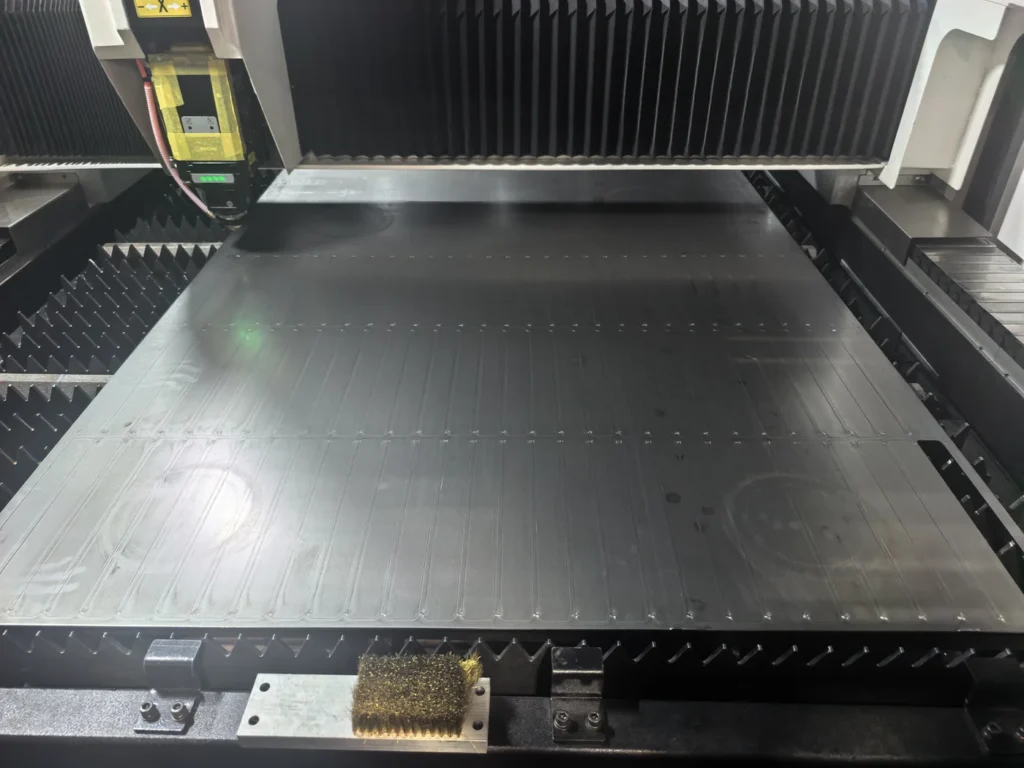
A 12 kW JQ-1530HP installation at a U.S. fabrication shop illustrates why actual working dimensions matter.
The delivered machine has a working area of 1,550 × 3,075 mm. Its 1,550 mm width was selected to accommodate the customer’s 5-foot-wide sheet stock.
Five feet equals 1,524 mm. The difference between the nominal sheet width and the stated working width is 26 mm in total.
That figure is not a universal positioning requirement, a per-side clearance specification or a statement of cutting accuracy. It describes the dimensional difference in this particular configuration.
For your own project, ask the supplier to confirm the working area and required positioning allowance against the sheets you intend to process.
4. Distinguish Working Area from Other Machine Dimensions
Machine literature may list working area, axis travel, table dimensions and overall machine dimensions. These figures describe different aspects of the equipment.
| Specification | What to Confirm |
|---|---|
| Working area | The specified processing range for the quoted configuration |
| Axis travel | The machine’s movement range and how it relates to the usable processing area |
| Table or support dimensions | How the sheet is supported and positioned |
| Overall machine dimensions | The equipment footprint, before confirming additional operating and service space |
Ask whether positioning, fixtures, edge conditions or the proposed process create restrictions within the stated working area.
Use the confirmed application conditions when preparing part layouts. Do not assume that every point within the advertised dimensions is available for every operation.
5. Review Your Parts and Nesting Layout
A sheet may fit the machine while the desired arrangement of parts still needs adjustment.
Provide representative drawings and typical order quantities so the supplier or programming team can review:
- Part dimensions and orientation.
- Spacing between parts.
- Edge allowances.
- Process-related restrictions.
- Remnant handling.
- Requirements for long or unusually shaped components.
A larger working area does not automatically produce better material utilization. Compare layouts using the same drawings, quantities and process assumptions.
If one large part drives your purchase decision, identify it early. Ask whether it can be processed within the proposed range without repositioning. Do not assume that material extending beyond the working area can be processed through an unspecified indexing method.
6. Include Loading, Unloading and Workshop Space
The cutting area is only one part of the installation.
Review how sheets will reach the machine and how finished parts and remnants will leave it. Confirm access for your handling equipment, operator access, maintenance clearances and space around moving tables where applicable.
Use the supplier’s installation drawing rather than estimating the required floor space from the cutting dimensions alone.
For larger or heavier sheets, include the stock weight and handling method in the discussion. A machine’s working dimensions do not establish its load capacity.
7. Compare Regular Production with Occasional Large Orders
Separate the requirements you need every day from those associated with a small share of orders.
Ask how each proposed configuration would handle both groups. Consider the equipment, workshop space, material flow and any additional operations required.
For example, a machine selected primarily for occasional large work may occupy more space than your regular production needs. A smaller format may introduce additional handling or processing steps for those larger jobs.
Compare these trade-offs using your actual order mix rather than choosing the largest available format by default.
Checklist: Information for a Working-Area Review
Prepare the following before requesting a configuration recommendation:
- Regular sheet dimensions: Width and length, with units clearly stated.
- Materials: Grades and thickness range.
- Sheet weight: Maximum weight, where known.
- Part drawings: Representative components and quantities.
- Largest finished part: Overall dimensions and critical features.
- Process restrictions: Orientation, edge requirements or limits on repositioning.
- Material handling: Proposed loading, unloading and remnant collection.
- Workshop layout: Available space and access restrictions.
- Future requirements: Planned work that could affect machine selection.
Request written confirmation of the working dimensions and application assumptions in the final quotation.
Discuss Your Plate Laser Working Area
Explore the JQ Laser plate cutting machine range and the JQ-1530HP product page.
Send your sheet dimensions, material list and representative drawings so our team can review the proposed working area and handling arrangement against your application.
Contact JQ Laser to discuss your plate cutting requirements.
