
If you cut pipes, tubes and profiles for a living, the laser-versus-plasma question comes up on every serious equipment purchase. Plasma tables have been the workhorse of structural shops for decades. Fiber laser tube cutting machines have been taking over a growing share of that work since the late 2010s. Which one should your shop buy — or add next?
The honest answer is: it depends on your material thickness, your part geometry and how much secondary work you currently do. This guide compares tube lasers and plasma cutters on edge quality, speed, thickness range, running cost and automation, and gives you a decision framework you can apply to your own part list.

The short answer
Choose a plasma cutter if your work is mostly heavy structural plate and pipe above roughly 30–40 mm wall thickness, where edge quality requirements are modest and purchase price is the dominant factor.
Choose a tube laser if you cut tubes and profiles up to 25–30 mm wall thickness and you need holes, notches, end profiles and weld-ready bevels in one pass — parts that today need sawing, drilling, notching and grinding as separate steps.
Many fabrication shops run both technologies side by side: plasma for the heavy plate and flame for the very thick sections, laser for everything that needs precision and welding preparation. The question is not “which technology wins” but “which one eliminates your most expensive bottleneck first.”
How plasma cutting works — and where it still shines
Plasma cutting ionizes gas into an electrical arc that melts metal, then blows it away. CNC plasma tables cut carbon steel, stainless and aluminum, and the technology is well proven in structural fabrication. Its real strengths:
- Thickness headroom. Plasma cuts metal well beyond 50 mm; on very thick structural sections it remains cheaper per machine-dollar than laser power.
- Lower purchase price. Professional CNC plasma tables in 2026 range from roughly US$13,000 to well over US$100,000 depending on size and power (market listings, Aug 2026) — typically well below an equivalent laser system.
- Simple operation. Setup and consumable replacement are straightforward, and trained operators are easier to find than laser programmers.

What plasma does poorly: edge quality and precision. Plasma edges are typically rougher, with a wider kerf (commonly around 1–3 mm) and a larger heat-affected zone (HAZ) — industry references commonly cite 0.5–2.0 mm HAZ for plasma versus roughly 0.1–0.5 mm for fiber laser. Dross on the underside usually needs grinding before welding. On thin and medium tube, plasma also cuts slower than laser because the process cannot focus energy as tightly.
How tube laser cutting works — and where it wins
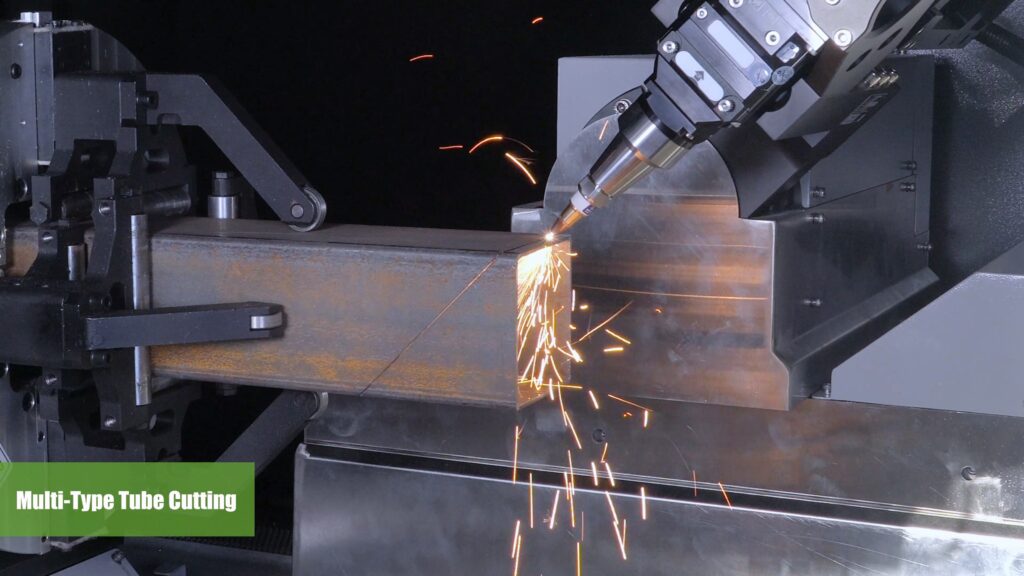
A fiber laser tube machine clamps the tube in chucks, rotates and feeds it while a 3D cutting head cuts holes, slots, end shapes and bevels. The laser beam has a very narrow kerf and a small HAZ, which is why laser-cut edges are consistently described as “weld-ready” with little or no grinding.
Key advantages for pipe and profile work:
- One-pass finishing. Cut-to-length, holes, notches, end profiles and weld-preparation bevels are done on one machine, replacing saw + drill + notch + grind.
- Precision. Positioning repeatability in the ±0.03–0.05 mm class (machine-dependent), with square edges and minimal thermal distortion — important for stainless pipework where plasma HAZ can start corrosion.
- Bevel cutting as standard. 3D cutting heads on machines like the JQ i-series produce bevels up to 45° for weld preparation, including on H-beams, channels and angles.
- Automation fit. Tube lasers integrate with automatic loading, nesting and production-monitoring software (JQ’s i-series runs MicroStep CyberFab), which suits the “digital shop floor” direction most fabricators are moving.
- Less waste. Two-chuck designs cut the last part with near-zero tailing residue, so expensive tube is not thrown away.
Where laser gives ground: on very thick sections (generally above 30–40 mm for carbon steel), the laser’s speed and cost advantage fades, and the capital cost of the power needed to compete becomes hard to justify. For those parts, plasma and oxy-fuel remain standard.
Side-by-side comparison
| Factor | Plasma cutting | Fiber tube laser cutting |
|---|---|---|
| Edge quality | Rougher; dross usually needs grinding | Smooth, square edges; little or no post-processing |
| Kerf width | Wide, commonly ~1–3 mm | Narrow (fraction of a mm at typical powers) |
| Heat-affected zone | Larger (industry refs ~0.5–2.0 mm) | Smaller (industry refs ~0.1–0.5 mm) |
| Thickness sweet spot | Medium to very thick; excels beyond ~30–40 mm | Thin to medium; economic up to ~25–30 mm carbon steel for most shops |
| Speed on thin/medium tube | Slower; wider kerf needs more energy per cut | Typically 2–3× faster on thin and medium steel (industry comparisons) |
| Holes, notches, bevels in one pass | No — separate operations or add-on bevel heads | Yes — 3D head, standard on tube lasers |
| Typical entry price (2026 market context) | CNC plasma tables from ~US$13,000 | Tube lasers from roughly US$15,000–30,000 (entry class) |
| Operating cost profile | Consumables: nozzles, electrodes, shields | Laser source, gas (O2/N2/air), protective windows, nozzles |
| Automation & software | Basic nesting on many tables | Nesting, CAM, production monitoring (e.g. CyberFab) |
| Best fit | Heavy structural plate, thick-wall pipe, low-tolerance work | Precision tube/profile parts, weld-ready bevels, high-mix production |
Figures are indicative 2026 industry context from public comparisons (Hypertherm, industry technical articles, Aug 2026), not quotations — always verify against your own cutting tests and a written quote.
The thickness question: where the crossover sits
Most shops overestimate how much very thick material they actually cut. It is worth counting your real workload by wall thickness before choosing. As a practical rule used in the shipbuilding sector: high-power fiber lasers (8–30 kW) handle ship steel efficiently up to roughly 30–40 mm, with 20–30 mm the zone where lasers are most often compared against plasma (industry technical articles, Apr 2026). Beyond that, plasma and oxy-fuel keep the advantage.
For a typical fabrication subcontractor whose tube work is 2–25 mm wall — handrails, frames, furniture and fitness parts, pipe spools, light structural — almost the whole workload sits inside the laser’s economic range. That is why so many shops have moved that band of work from plasma to tube lasers.
Cost per part: more than the purchase price
Plasma looks cheaper at the invoice and often is cheaper on very thick work. But for thin-to-medium tube, compare the full picture:
- Labor. Plasma-cut parts usually travel to a grinder or a secondary station. Laser-cut parts go straight to welding or assembly.
- Gas and consumables. Plasma nozzles and electrodes wear quickly; laser consumables (protective windows, nozzles) also matter, and high-power lasers increasingly cut carbon steel with compressed air, which lowers gas cost.
- Rework and scrap. Tighter tolerances and less distortion mean fewer rejected parts and less material waste — nesting software typically improves material utilization by 15–20% on either technology.
- Automation. A laser that loads itself and runs lights-out changes the labor math entirely; plasma tables are less commonly automated.
Weld rework is where laser quality pays its biggest dividend in structural work. In a widely cited early adopter case, a 12 kW fiber laser installation at Hyundai Heavy Industries cut welding rework by roughly 90% on hull plate assembly. Quality that reduces downstream rework is real money, not a marketing slogan.
A decision framework for your part list
- List your parts by wall thickness. What share is under 25 mm? Over 40 mm? If the thick band dominates, plasma (or oxy-fuel for the very thickest) stays relevant.
- Count your secondary operations. How many hours a week go to sawing, drilling, notching and grinding tube? Each one is a candidate for elimination by a tube laser.
- Check the geometry. Holes, slots, end cuts and bevels on round and square tube are tube-laser territory; straight cut-off and heavy plate are plasma territory.
- Estimate utilization. The machine that runs most hours should come first. A plasma table that sits idle is no bargain; neither is a laser.
- Run a test. Send your real parts (not a supplier’s demo part) for a cutting test on both technologies and compare edge quality, cycle time and post-processing.
For most tube-heavy subcontractors, the tube laser is the better first investment because it removes the most manual operations. See the i-series tube laser buying guide for a model-by-model comparison of tube machines.
FAQ
Is laser cutting better than plasma cutting?
For thin and medium metal (roughly up to 25–30 mm carbon steel), fiber laser cutting generally wins on edge quality, speed and consistency. For very thick plate, plasma remains competitive on cost. “Better” depends on your thickness range and quality needs.
Can plasma cut tubes and pipes?
Yes — CNC plasma systems cut pipe, often with bevel options. But for holes, notches and complex end profiles on tube, a 3D tube laser does the work in one pass with better edge quality and less downstream grinding.
How thick can a plasma cutter cut?
Production plasma systems cut carbon steel well beyond 50 mm depending on power; laser cutting is most economic well below that. Above roughly 30–40 mm, plasma and oxy-fuel keep the advantage.
Is plasma cutting cheaper than laser cutting?
Plasma machines cost less to buy, and running cost per part can be lower on very thick material. On thin and medium tube, laser’s higher throughput and reduced secondary work often make total cost per finished part lower.
Why are shops replacing plasma with fiber laser?
Industry comparisons commonly cite 2–3× faster cutting on thin and medium steel, laser-clean edges with no grinding, and better automation fit. The change is most visible in shops whose work sits in the laser’s economic thickness range.
Does laser cutting prepare tube for welding?
Yes. A 3D tube laser cuts bevels up to 45° for weld preparation on round, square and rectangular tube, angles, channels and H-beams — parts arrive weld-ready, which is a major reason shipyards and structural fabricators have adopted tube lasers. See our shipbuilding laser cutting guide for real yard applications.
Get a recommendation for your material
Send your part list (materials, wall thicknesses, tube sizes, monthly volumes) to info@jqlaser.com or WhatsApp +86 151-541-42241 — JQ Laser responds within 24 hours, and sample cutting on your real parts is free.
Related reading:
tube laser vs plate laser, fiber laser plate cutting machines, and the JQ i-series models & specs guide.
